
Mon - Frid: 10:00 - 18:00 info@lagrimatonewood.com

Mon - Frid: 10:00 - 18:00 info@lagrimatonewood.com
African Blackwood
Family: Fabaceae | Order: Fabales | Class: Magnoliopsida
Scientific name: Dalbergia melanoxylon
Trade name: African Blackwood / Grenadille Afrique
Also known as:
- African grenadillo (United Kingdom)
- Mpingo (Tanzania)
- Grenadilla (Mozambique)
- Pau-Preto (Mozambique)
- Ébène du Mozambique (France)
- Afrikanisches Grenadille (Germany)
Origin: East and Central Africa, from Sudan to Mozambique, Angola, and Senegal.
Instrumental Uses
Used for guitar backs and sides, fingerboards, bridges, headplates, bindings, pegheads, turnery, and woodwind and string instrument parts.
Tonal Properties
African Blackwood has a glassy tap tone, ringing like a bell with deep bass, bright trebles, and exceptional sustain. It projects sound powerfully, offering a clear tone, strong voice, articulate bass, and concise attack. It has all the desirable acoustic properties of rosewood but with greater volume and voice separation. Some luthiers consider it as good as a fine Brazilian rosewood set when paired with the right top, delivering a fast low-end response and a rich harmonic presence that contributes to a powerful and complex sound.
Among the most expensive lumbers, its small tree size makes it difficult to obtain pieces large enough for guitar backs. Due to its density and natural oils, it can be challenging to work with but finishes beautifully, polishing to a high luster. It is a dense, stiff, and strong wood, with an average dried weight of 79 lbs/ft³ (1270 kg/m³).
Botanical Information
Dalbergia melanoxylon grows in a variety of environments, from sea level to 1,050 meters in altitude. The tree is highly branched, typically multi-stemmed and small, reaching 5 to 8 meters in height, though it can occasionally grow up to 16 meters. The trunk is short, straight, and often fluted, rarely exceeding 30 cm in diameter.
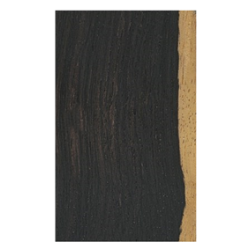
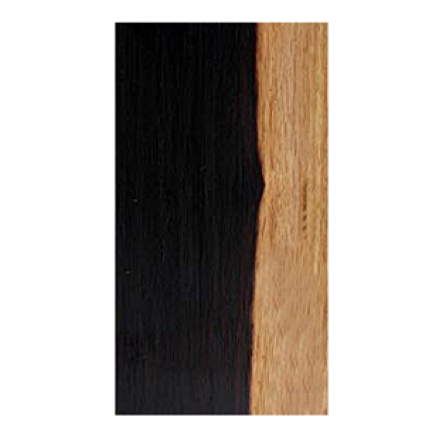
The sapwood is pale brown to yellowish-white, sometimes with dark streaks, and can be up to 15 cm thick. The heartwood is nearly black, black-brown, or dark brown with black streaks, clearly distinct from the sapwood.
Conservation Status
- CITES Appendix II – Regulated to prevent overexploitation
- IUCN Red List – Near Threatened
Gallery Photos